
-8%
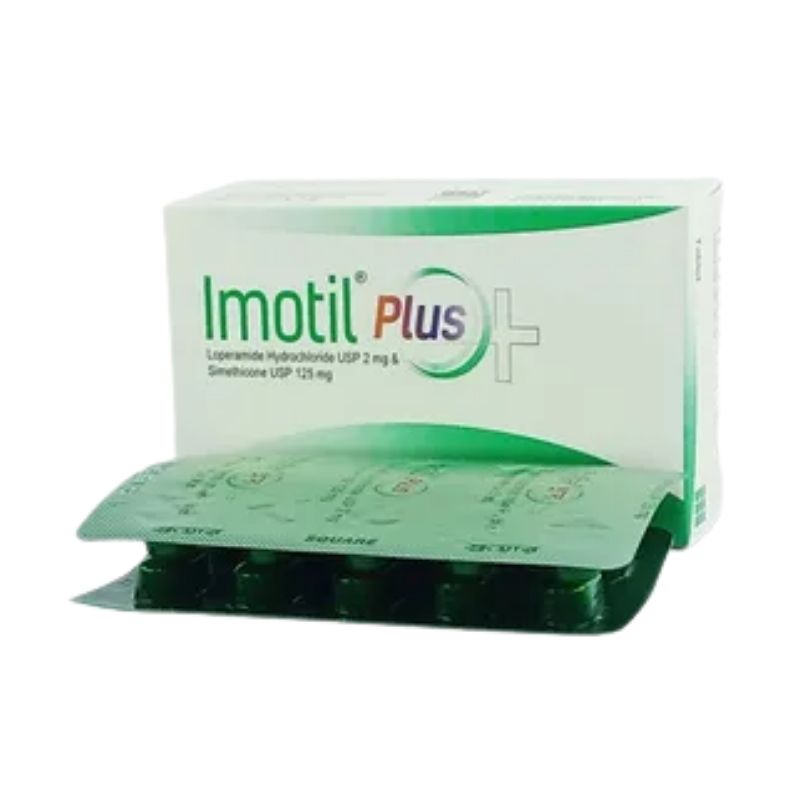
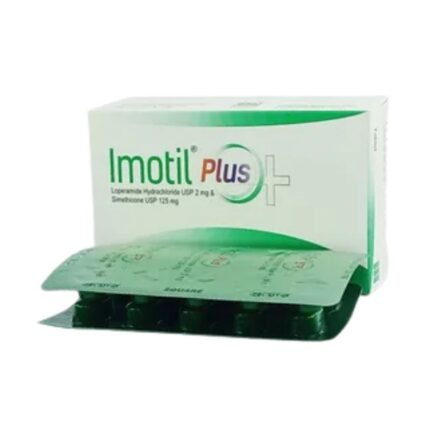
Imotil Plus tablet – (2mg+125mg)
Original price was: 50.00৳ .46.00৳ Current price is: 46.00৳ .
Square Pharmaceuticals PLC.
Generic: Loperamide + Simethicone
10 Tablets (1 Strip)
| Weight | 0.015 kg |
|---|
0
People watching this product now!
Description
Indications
It is indicated for the symptomatic treatment of acute diarrhea in adults and adolescents over 12 years when acute diarrhea is associated with gas-related abdominal discomfort including bloating, cramping or flatulence.
Pharmacology
Loperamide binds to the opiate receptor in the gut wall, reducing propulsive peristalsis increasing intestinal transit time and enhancing resorption of water and electrolytes. Loperamide increases the tone of the anal sphincter Simethicone is a surface-active agent with anti-foaming properties thereby potentially relieving gas related symptoms associated with diarrhea. Most ingested Loperamide is absorbed from the gut. But due to significant first pass metabolism systemic bioavailability is approximately 0.3% Simethicone is not absorbed The plasma protein binding of Loperamide is 95% Loperamide is almost completely extracted by the liver, where it is predominantly metabolized, conjugated and excreted via the bile. The half-life of Loperamide is about 11 hours. Excretion of the unchanged Loperamide and the metabolites mainly occur through the faeces.
Dosage & Administration
Adults and children 12 years of age and older: 2 Tablets after the first loose bowel movement and one tablet or caplet after each subsequent loose bowel movement, up to a maximum of 4 tablets or caplets a day for no more than 2 days.
Children 6-11 years of age: This is not recommended for children under 12 years of age except on the advice of a physician.
The proposed dose that may be used: 1 Tablet after the first loose bowel movement and 1/2 tablet or caplet after each subsequent loose bowel movement, up to a maximum 3 tablets or caplets (for ages 9-11 years) or maximum 2 tablets or caplets (for ages 6-8 years) per day, for no longer than 2 days.
Children under 12 years of age: This tablet should be used with special caution in children under 12 years of age because of greater variability of response and possible difficulty of swallowing.
Geriatrics (> 65 years of age): No dose adjustments are required for the elderly.
Renal Impairment: No dosage adjustment necessary in renal impairment.
Hepatic Impairment: Although no pharmacokinetic data are available in patients with hepatic impairment, this tablet should be used with caution in such patients because of reduced first pass metabolism.
Administration: This tablet should be taken by mouth and can be taken at any time of day. The caplets should be taken with a full (250 mL) glass of water. The chewable tablets should be chewed fully and then swallowed. Drink plenty of clear fluids to help prevent dehydration which may accompany diarrhea. Take only on an empty stomach (1 hour before or 2 hours after a meal).
Interaction
Non-clinical data have shown that loperamide is a P-glycoprotein substrate. Concomitant administration of loperamide (16 mg single dose) with quinidine, or ritonavir, which are both P-glycoprotein inhibitors, resulted in a 2 to 3-fold increase in loperamide plasma levels. The clinical relevance of this pharmacokinetic interaction with P-glycoprotein inhibitors, when loperamide is given at recommended dosages, is unknown.
The concomitant administration of loperamide (4 mg single dose) and itraconazole, an inhibitor of CYP3A4 and P glycoprotein, resulted in a 3 to 4 fold increase in loperamide plasma concentrations. In the same study a CYP2C8 inhibitor, gemfibrozil, increased loperamide by approximately 2 fold. The combination of itraconazole and gemfibrozil resulted in a 4 fold increase in peak plasma levels of loperamide and a 13 fold increase in total plasma exposure. These increases were not associated with central nervous system (CNS) effects as measured by psychomotor tests (i.e., subjective drowsiness and the Digit Symbol Substitution Test).
The concomitant administration of loperamide (16 mg single dose) and ketoconazole, an inhibitor of CYP3A4 and
P-glycoprotein, resulted in a 5 fold increase in loperamide plasma concentrations. This increase was not associated with increased pharmacodynamic effects as measured by pupillometry.
Concomitant treatment with oral desmopressin resulted in a 3 fold increase of desmopressin plasma concentrations, presumably due to slower gastrointestinal motility.
It is expected that drugs with similar pharmacological properties may potentiate loperamide’s effect and that drugs that accelerate gastrointestinal transit may decrease its effect.
Since simethicone is not absorbed from the gastrointestinal tract, no relevant interactions between simethicone and other drugs are expected.
Contraindications
Patients who are hypersensitive to this drug or to any ingredient in the formulation or component of the container. For a complete listing, see the Dosage Forms, Composition and Packaging section of the product monograph.
Loperamide hydrochloride/Simethicone is contraindicated for use in children under 2 years of age.
Loperamide hydrochloride/Simethicone is contraindicated in those in whom constipation must be avoided.
Loperamide hydrochloride/Simethicone should not be used in the case of acute dysentery that is characterized by blood in stools and elevated temperature. Fluid and electrolyte depletion may occur in patients who have diarrhea. The use of Loperamide hydrochloride/Simethicone does not preclude the administration of appropriate fluid and electrolyte therapy.
Loperamide hydrochloride/Simethicone should not be used in patients with bacterial enterocolitis caused by invasive organisms including Salmonella, Shigella, and Campylobacter.
Loperamide hydrochloride/Simethicone must not be used in patients with acute ulcerative colitis or pseudomembranous colitis associated with broad-spectrum antibiotics. In such patients, agents which inhibit intestinal motility or delay intestinal transit time have increased the possible risk of significant sequelae including ileus, megacolon and toxic megacolon . Loperamide hydrochloride/Simethicone therapy should be discontinued promptly if abdominal distention occurs or if untoward symptoms develop. In general, Loperamide hydrochloride/Simethicone should not be used when the inhibition of peristalsis is to be avoided.
Side Effects
The safety of Loperamide-Simethicone was evaluated in 2040 patients in five clinical trials. The most commonly reported (i.e. 21% incidence) ADRs: dysgeusia (2.6%) & nausea (1.6%).
Pregnancy & Lactation
Safety in human pregnancy has not been established. Animal studies show no indications of teratogenic or embryotoxic properties. It should not be given during pregnancy, especially during the first trimester, unless clinically justified. Small amounts of Loperamide may appear in human breast milk. Therefore, it is not recommended during breast feeding.
Precautions & Warnings
Treatment of diarrhea with Loperamide-Simethicone is only symptomatic. Whenever an underlying etiology can be determined, specific treatment should be given. If clinical improvement is not observed within 48 hours, the administration of Loperamide-Simethicone must be discontinued. This medicine must be used with caution in patients with hepatic impairment as it may result in a relative overdose leading to central nervous system (CNS) toxicity. Loperamide-Simethicone should be used under medical supervision in patients with severe hepatic dysfunction. Cardiac events including OT interval and QRS complex prolongation. have been reported in association with overdose.
Storage Conditions
Keep below 30°C temperature, away from light & moisture. Keep out of the reach of children.
Reviews (0)
Only logged in customers who have purchased this product may leave a review.
Related products
-1%
Rytary Capsule 145mg (100pcs Pot)
Original price was: 8,500.00৳ .8,450.00৳ Current price is: 8,450.00৳ .
-5% Sold out
Carboplatin PhaRes 150 mg/ml
Original price was: 2,400.00৳ .2,280.00৳ Current price is: 2,280.00৳ .
-7% Sold out
-10%
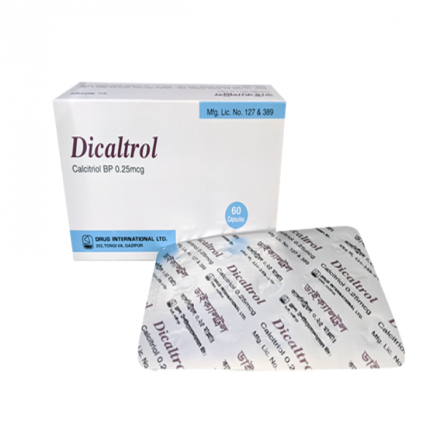
Cap. Dicaltrol 0.25mg
Original price was: 180.00৳ .162.79৳ Current price is: 162.79৳ .
-10%
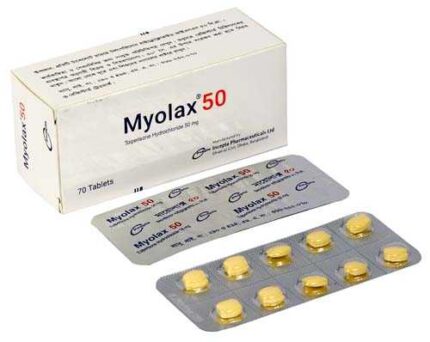
Tab. Myolax 50mg
Original price was: 90.00৳ .81.10৳ Current price is: 81.10৳ .
-10%
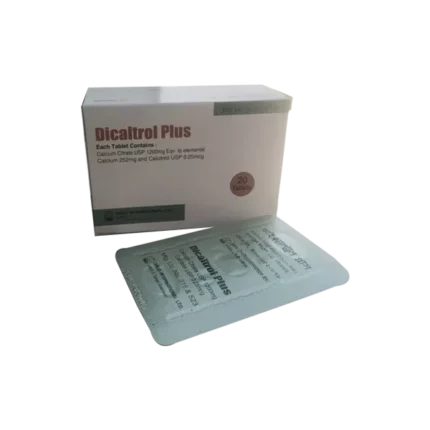
Dicaltrol Plus 0.25mcg/252mg
Original price was: 65.00৳ .58.78৳ Current price is: 58.78৳ .
-10%
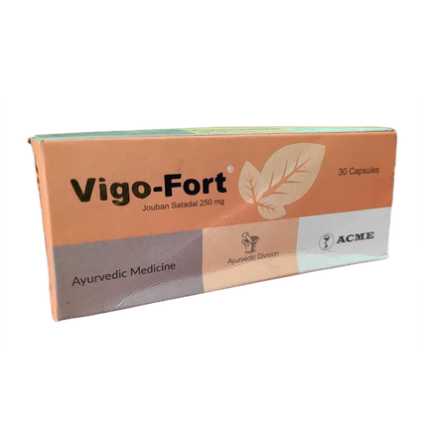
Cap. Vigo Fort 250mg
Original price was: 120.00৳ .108.00৳ Current price is: 108.00৳ .


Reviews
There are no reviews yet.